
Educational Practices in Environmental Informatics and Green Coding
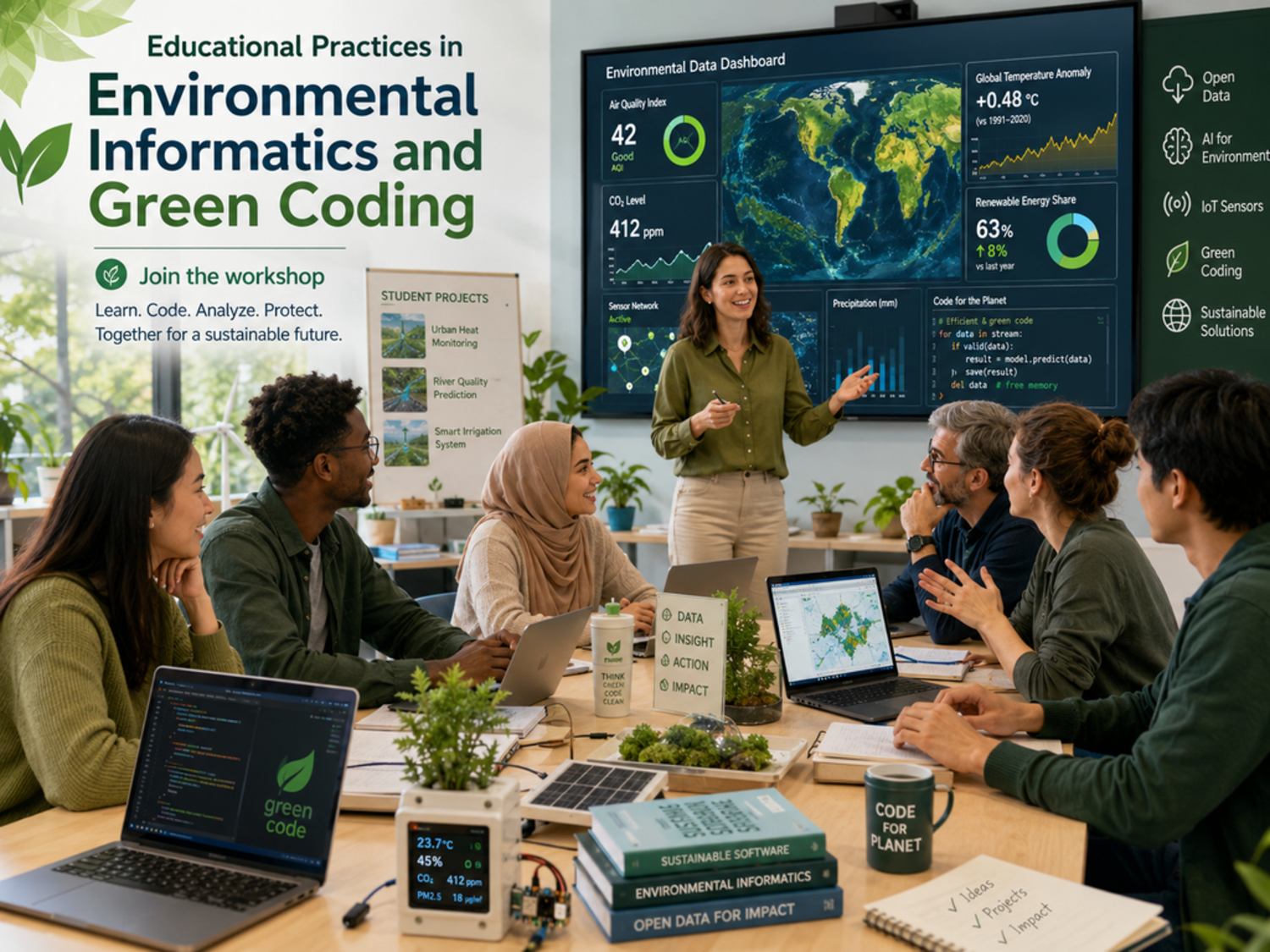
This workshop provides a platform for exchanging ideas on innovative teaching and learning formats in the fields of Environmental Informatics and Green Coding. It focuses on practice-oriented lab and project-based formats that help students develop both technical skills and an awareness of topics in environmental informatics and sustainable software development.
Contributors are invited to present their didactic approaches, experiences, and challenges in implementing such courses in higher education. The workshop encourages discussion of best practices, curriculum integration, and evaluation strategies.
The program can be complemented by demonstrations and live showcases, making concrete teaching scenarios and technical implementations tangible. The goal is to collect best practices, spark new ideas, and support the advancement of education at the intersection of computing and sustainability.
Possible contributions
- Project-based learning formats in Environmental Informatics.
- Integration of sustainability topics into computer science curricula.
- Tools and platforms for measuring and teaching energy-efficient software.
- Experiences with interdisciplinary teaching (e.g., combining computing with environmental sciences).
- Experiences in international co-teaching in environmental informatics (for example: common student projects and common lessons online, ERASMUS-exchange)
- Evaluation methods for learning outcomes in sustainability-focused courses.
- Student projects, hackathons, or challenge-based learning formats.
- Teaching materials, open educational resources, or reusable lab concepts.
- Reflections on challenges, barriers, and success factors in implementing such courses.
- Results and demonstrators from Research Projects on Environmental Informatics at National and European Levels.
- Use of AI and machine learning methods for environmental data analysis and prediction (e.g., forecasting air quality, energy demand, or climate indicators).
- Teaching digital carbon footprint analysis: methods and tools for measuring and reducing the environmental impact of software systems and data centres.
- Integration of open data sources (e.g., Copernicus, OpenStreetMap, national environmental agencies) into student projects and practical exercises.
- Citizen science and community-based monitoring projects: engaging students in real-world data collection for environmental informatics (e.g., noise mapping, water quality, urban heat islands).
- Experiences with gamification and simulation environments for teaching sustainable resource management and climate modelling.
- Cooperation with industry and public authorities: formats for integrating real-world environmental problems into academic teaching (e.g., internships, sponsored projects, guest lectures).
Contributions are possible as talk only, or also as short / full papers. Especially hands-on experiments for students are welcome (Air Quality, Building Efficiency, Sensors, IoT, Open Data, energy demands of software etc.)
Workshop Chairs:
- Stefan Naumann, Institute for Software Systems@Environmental Campus Birkenfeld, Trier University of Applied Sciences, s.naumann@umwelt-campus.de
- Volker Wohlgemuth, Environmental Informatics Unit, HTW Berlin, University of Applied Sciences, volker.wohlgemuth@htw-berlin.de
To ensure you don't miss any information about our EnviroInfo conference series, please subscribe to our email list at https://lists.gi.de/postorius/lists/enviroinfo.lists.gi.de/.
